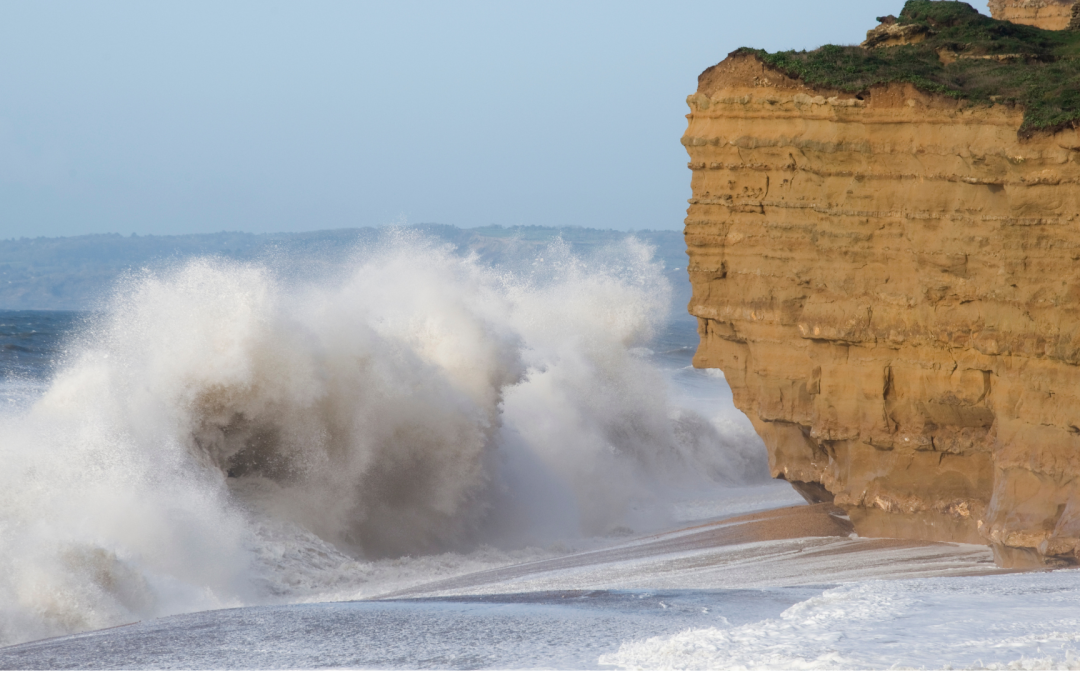
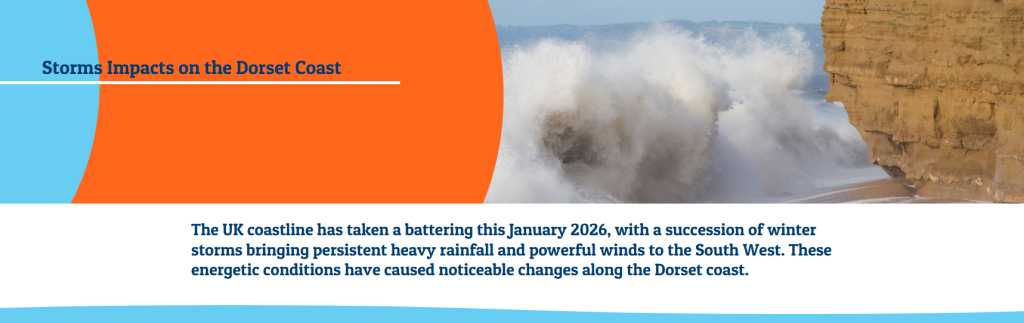
With spring sunshine finally arriving and winter storms now (hopefully) behind us, we thought it was the perfect time to share a closer look at how those storms have shaped our coastline.
The Dorset coast took a significant battering during the January storms, and we’ve pulled together a new page on the DCF website highlighting the key changes, unusual impacts, and stories from across our coast.
Thank you to our partners who have already contributed images, videos and local insights. If you have photographs of the beaches where you work or live that show recent storm impacts, we’d love to include them, please send them to us.
Please take a moment to explore the new page, share it with your networks.
Sharing these helps us raise wider awareness of how dynamic our coastline is.
2026 is a landmark year for the Jurassic Coast World Heritage Site, marking 25 years since the Dorset and East Devon Coast was awarded UNESCO World Heritage status.
A big thank you to Molly Webb, our volunteer, who has created a brand new webpage to showcase the events taking place throughout this anniversary year.
If you’re planning any activities or celebrations, big or small, we’d love to hear about them. Sharing your events helps us highlight and promote the fantastic work happening across the Jurassic Coast.
Two dates in particular we are keen for events to celebrate the Jurassic Coast are;
18th April – World Heritage Day
6th October – International Geodiversity Day
Please contact us with your events to include on the new page.
The World Heritage Day Festival is a full‑day celebration showcasing Dorset’s natural and cultural heritage through talks, tours, hands‑on activities and family‑friendly workshops. The festival brings together museum specialists, guest heritage organisations and the public to explore the stories, science and collections behind our World Heritage landscape.
Event Highlights
The programme offers a mix of bookable and drop‑in experiences, designed to engage visitors of all ages:
Talks
Hosted in the Community Space throughout the day
Free and open to everyone (no Museum ticket required)
Limited capacity of 40 per session
Talk tickets do not include Museum entry, and Museum tickets do not guarantee talk places
Collections Discovery Centre Tours
Three behind‑the‑scenes sessions themed “Become a Curator”
Visitors explore fossil collections not on display and learn simple condition‑checking techniques
Limited to 12 people per session due to space
Free to book through the website
Museum Activities (Drop‑in – Free with Museum Ticket)
Guided Gallery Tours
Natural Dorset Gallery with Sam
People’s Dorset Gallery with Steve
“Bring Your Collection” Sessions
Sam identifies fossils brought in by children and shares insights in three sessions during the day
Storytelling Sessions in the Story Space, Hardy Gallery
Arts & Crafts (self‑guided)
Family Activities delivered by guest organisations in the Victorian Hall
Guest Organisations
Confirmed contributors include:
Charmouth Heritage Trust
English Heritage
National Trust
Dorset National Landscape Partnership
Ticket Information
£15.50 for adults (26+)
£13 for young adults (16–25)
Free for children (0–15), Art Fund members, Museums Association members and Wessex Museums holders
10% off tickets available on the day
Tickets are valid for one year during normal opening hours, offering unlimited returns, including Special Exhibitions
Booking
All bookable events (talks and Collections Discovery Centre tours) will be available to reserve via the museum’s website.
A huge thank you to everyone who joined us for the Dorset Coast Forum Annual Conference on 19th November. This year was extra special as we celebrated 30 years of Dorset Coast Forum – a fantastic milestone for our coastal community!
The event was a great success, with 100 members coming together to enjoy 12 inspiring presentations, grouped into three thought-provoking sessions:
Rising to the Challenge: Navigating Climate and Ecological Crises
The Changing Tides: Fishing and Marine Nature Recovery
Shorelines and Stories: Building Coastal Community Connections
We’re incredibly grateful to our speakers for their engaging contributions, the information stand exhibitors, our hosts at RNLI College in Poole, and our generous sponsors: Suttle Projects, who sponsored the conference and DCF’s 30-year celebration and Moffatt & Nichol who sponsored their information stand.
25th Anniversary of the Jurassic Coast World Heritage Site
2026 marks 25 years since the Jurassic Coast was inscribed as a World Heritage Site for its exceptional and globally valuable geology, palaeontology and coastal geomorphology.
In celebration of this milestone, many stakeholders along the World Heritage Site are running special events and exhibitions. We will be helping to promote these events and have created a 25 year logo to help mark celebrations that are associated with the anniversary. See the full eNews for events planned in your area.
Do you have any events you would like to use to celebrate the 25th anniversary of the WHS? Contact us to let us know!
Schools across Poole and Purbeck are invited to celebrate Outdoor Classroom Day on 21 May 2026 with DCF and partner organisations including South West Flood & Coastal, Andrew Simpson Centres and Litter Free Dorset. Co‑hosted this year by the National Trust, the event will take place at Shell Bay, Studland. Following a successful 2025 event engaging 7 schools and over 160 pupils, this free day of outdoor STEM activities (suitable for Years 5–9) promises even more fun and learning.
Data from the 2025 boating season shows strong positive outcomes for the SBMP Eco‑Mooring Project, which protects Dorset’s largest seagrass meadow. All 87 eco‑moorings were well used, alongside continued scientific research led by the University of Southampton. SBMP volunteers analysed over 45,900 time‑lapse images monitoring compliance with the Voluntary No Anchor Zone (VNAZ). Results show excellent behaviour by boaters:
73% used a mooring
14% anchored outside the VNAZ
Just 8% anchored within seagrass meadows — a significant reduction from previous years
Encouraging signs of seagrass recovery were recorded in former anchor scars, alongside the highest number of seahorse sightings to date during monitoring dives.
While compliance remains high, paid mooring use reached 45%, an improvement on 2024 but still below the level needed to sustain the project long‑term. Continued support is vital to ensure eco‑moorings remain available in future seasons.
Are you studying Environmental Sciences, Engineering or Geography at GCSE or A Level?
Future Coast North Swanage are looking to select GCSE or A Level Environmental Sciences, Engineering or Geography students from the local area to join our unique Coastal Adaptation Pathways Student panel in February 2026.
Applications are invited from anyone looking to enhance their knowledge and experience and help establish their own career pathway.
What is an Coastal Adaptation Pathway?
A Coastal Adaptation Pathway is a strategic approach used in coastal management to plan for long-term change, especially in response to climate impacts like sea-level rise, erosion, and flooding. Instead of committing to one fixed solution, it lays out a sequence of actions over time, allowing flexibility as conditions evolve. Here’s what it involves:
Step-by-step planning: Actions are staged over decades, starting with low-cost or reversible measures and moving toward more significant interventions if needed.
Trigger points: Decisions are linked to indicators (e.g., rate of erosion, sea-level rise thresholds) so that adaptation happens when it’s necessary.
Multiple options: It considers different scenarios and pathways, so communities can adapt without locking into one expensive solution too early.
Community and stakeholder input: Ensures that social, economic, and environmental priorities are integrated.
In short, it’s about planning for uncertainty and keeping options open, rather than trying to “fix” the coast permanently.
Why should you be on our student panel?
Young voices ensure plans reflect the needs of future generations, not just today’s priorities.
Adaptation pathways influence how we safeguard beaches, wildlife, and cultural sites. Your input helps balance environmental protection with community use.
Participating gives experience in planning, sustainability, and climate resilience—skills that are valuable for careers and leadership roles.
Young people often see issues differently—like affordability, accessibility, and social spaces. Your perspective helps make plans fair for everyone.
This is a chance to take real action on climate change locally, not just talk about it. You’ll help create practical solutions for rising seas and erosion.
What do I need to do?
Complete this form by 16th January 2026: tell us more about you, what you are studying, what you plan to do in the future, what participation in the panel means for you. Spaces are limited so if we are over-subscribed we will choose the top 12 applicants.
Successful applicants: if you make it onto the panel you will be expected to attend an online student panel meeting at least every 4 months with the opportunity to attend in person adaptation planning events with the Future Coast North Swanage team.
Stakeholder input: as a valued stakeholder you will be expected to share your opinions as the plan is created so we are looking for critical thinkers able to share their ideas and present to a wider audience either in their own educational setting or externally.
This application form will be open until Friday 16th January 2026 12 noon